Report Guernsey Colour Ringed Gulls

Sightings of Guernsey colour ringed Gulls can be entered here for an instant life history, or sent to pkv@cwgsy.net for a life history to be returned by e-mail to observers.

Sunday, August 11, 2013

Colour-Ringed Ruddy Turnstone

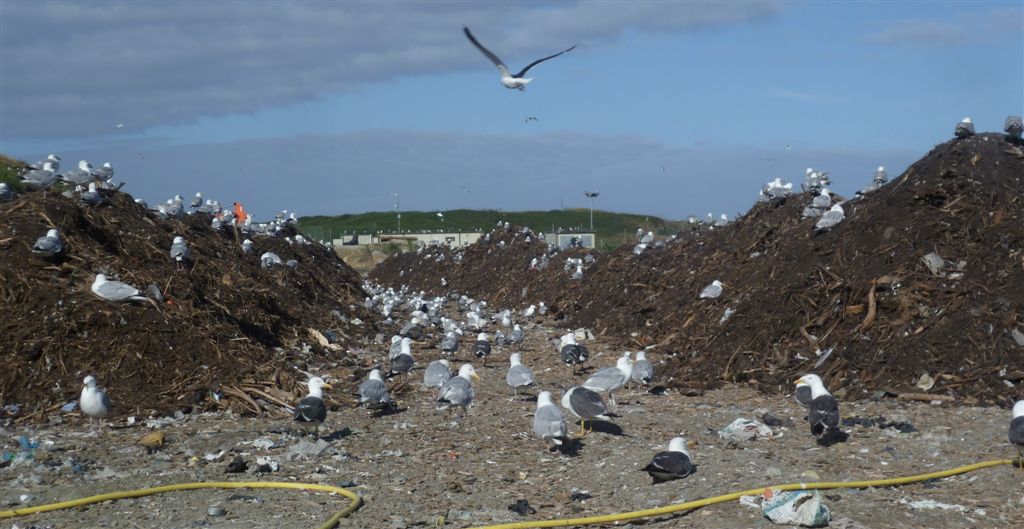
The weekend produced some very nice colour ring reading at Chouet Landfill and the beaches of the north and east coast of Guernsey. Although numbers of adult Lesser Black-backed Gulls are thinning out as more birds migrate south, there are still plenty of birds around. The moulting gull flock on Pembroke was also almost 1,000 birds on Sunday morning, and in the "nursery" on the shoreline were a couple of juvenile cr Herring Gulls and my first rarity of the autumn - a Guernsey cr juvenile LBBG (Black 1CC6 from Sark).
At Bellegreve Bay this morning there were at least 14 Mediterranean Gulls (two juveniles); two cr birds seen the previous week (White 3E90 and Green RN09) and three metal-ringed birds. The biggest surprise of the weekend, however, was a colour-ringed Ruddy Turnstone. I'm not sure where this bird was ringed...hopefully all will be revealed soon?!
Ruddy Turnstone with Yellow Flag and Colour Ring (c) PKV
Mediterranean Gull White 3E90
 Gull Flock on Pembroke Beach
GBBG Black 50J from Seine-Maritime, France


Gulls at Chouet landfill (all photos (c) PKV)

Friday, August 9, 2013

Seabirds at Sea

It was a privilege to be invited on board when on 7th August 2013 Chris Morris and Sea Fisheries staff undertook a routine fisheries patrol in the 6 – 12 mile fisheries controlled zone off Guernsey’s west coast. Conditions for observing seabirds at sea were excellent with a gentle breeze, slight sea and overcast conditions. Fortunately rain was only light and sporadic, clearing soon after mid-day.

During the day fisheries personnel inspected four vessels - three French Demersal Trawlers (wet fish) and one English Scallop Dredger. 

Grand Total of Seabirds Observed:
Lesser Black-backed Gull 480+ (c 20% juveniles)
Northern Fulmar 73+
Herring Gull 56
Northern Gannet 48
Great Black-backed Gull  9
European Storm-petrel   7
Great Skua  5
Balearic Shearwater  3
Manx Shearwater  2
Common Tern 2
Sooty Shearwater  1

GRAND TOTAL = 686 birds

Conclusions
  1. In the 6 – 12 mile zone offshore from Guernsey's west coast, the commonest seabird in early August was Lesser Black-backed Gull ( 70%  of all sightings) - LBBGs outnumbered Herring Gulls in this zone 480:56  (around 8.6:1);
  2. Many of the LBBGs observed were carrying colour rings fitted in Guernsey or Alderney (but none could be read given the movement on the sea);
  3. Northern Fulmars were surprisingly common (73+ birds);
  4. There were comparatively few Northern Gannets (only 48 birds);
  5. Demersal Trawling provides significant discards for seabird (but the cleanest boat held significantly less birds that boats which spilt more fish on deck and tossed by catch back in the sea very quickly);
  6. Scallop Dredging provides very little food for seabirds and is of little interest to them; and
  7. The records of Great Skua, Sooty Shearwater and Common Terns show that autumn passage of northern breeding seabirds is underway.


Thursday, August 8, 2013

GuernseyGulls Presents to GSPCA Staff

Earlier in the week, GuernseyGulls was very pleased to give a short presentation on its gull research work to the staff of the Guernsey Society for the Prevention of Cruelty to Animals (GSPCA). Every year the GSPCA handles around 50 gulls with various sicknesses or injuries. After care and treatment many of these gulls are rehabilitated and are able to be released back in to the wild. For several years gulls have been colour ringed before release to determine survival rates. It is very pleasing to report that through this work we know that many rehabilitated gulls are able to resume their lives normally and we have several examples of birds that have even managed to complete migrations to and from Portugal or France following release after care and treatment.
The GSPCA report on this visit can be found on the Society's excellent web site:- 

Gulls Ringed and Ready for Release at GSPCA


Sunday, August 4, 2013

25 Small Gulls = 4 Foreign Colour Rings (Plus Two Metal Onlys)

With a headline like that...you just know that I must be talking about Mediterranean Gulls! Today I visited Bellegreve Bay to see if the regular late summer passage migrant Mediterranean Gull White 3E90 (ringed at Zandvlietsluis, Antwerp, Belgium is back for its 7th consecutive late summer in Guernsey. It is!
However...amongst the ten Mediterranean Gulls seen at Bellegreve Bay, there were two more colour-ringed birds - a Juvenile Green RN09 (presumably from Pas-de-Calias, France) and White E898 (A 2nd year bird from either Belgium or The Netherlands). Incredibly two more of the Mediterranean Gulls were metal ringed only (both on tibias) - so 50% of the Mediterranean Gulls observed were ringed. 
One of the 15 Black-headed Gulls was also colour-ringed - White TARM. This gull was ringed at Pryzkona Reservoir, Turek, Poland as a 2nd year bird in May 2010. It has now been recorded in the four consecutive following autumns/winters in Guernsey!


Wednesday, July 31, 2013

Arctic Traveller

In early April this year Lesser Black-backed Gull Black JR42 was seen on Chouet Beach. This gull was on passage back to Norway. What made this sighting extra special was the discovery that it is one of the gulls nesting in the far north of Norway, way up in the Arctic Circle on the Island of Loppa in Finnmark. The life history of this gull showed that it had been ringed as a chick in July 2006, and that it is has spent significant parts of intervening winters in Spain. However, until yesterday the gull had not been recorded back at its natal colony. After passing through Guernsey this spring, Black JR42 did return to Loppa, where gull enthusiasts Morten Helberg and Arild Breistol recorded it yesterday.
LBBG Black JR42 on Chouet Beach, Guernsey - April 2013 (c) PKV
The Movements of Black JR42

Young Gulls Invade the Beaches

It's a great time of year. The season's seabird monitoring work is over for another year, so I can just grab the scope again and head for the beaches or landfill early in the mornings - simply to enjoy the gulls...and it's always really good to see the invasion of the beaches by juvenile gulls! Every year I wonder what I did with my time...because hardly any juvenile gulls seem to be colour-ringed! Most of these early juveniles will be Channel Island bred birds...but many nest in inaccessible places. At least I found five cr juvenile Herring Gulls in the hoards of youngsters today. Most of the juveniles are Herring Gulls, but there are also a few Great Black-backed Gulls and today my first Lesser Black-backed Gulls (always very smart...but none with colour rings!).


Gulls at Chouet Landfill Beach (c) PKV